.webp?width=130&height=24&name=SuprConfig%20(2).webp)



 Book a migration call


Salesforce to HubSpot Migration: A Complete Guide to Data, Process & Best Practices
-
Ujjwal

- Date: August 24, 2026
- 19 min read

Config delivers 3,000 HOURS OF TIME-SAVINGS for a logistics-focused HubSpot Solutions Partner
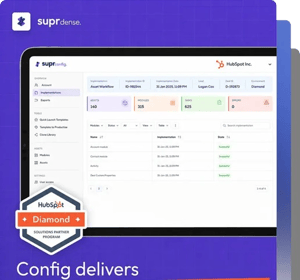
How a logistics-focused HubSpot Solutions Partner reclaimed 3,000 hours in one month with Config
Read Full Case Study Not sure where to start? Talk to a migration expert

Migrate to HubSpot and connect your favouritetools all in one platform.

Migrate to HubSpot and connect your favouritetools all in one platform.
How we consolidated years of data from Salesforce org and a legacy HubSpot Portal into a new HubSpot Instance for Salted Stone

How we consolidated years of data from Salesforce org and a legacy HubSpot Portal into a new HubSpot Instance for Salted Stone
Read Full Case Study
Not sure where to start? Talk to a migration expert
Import, create, and deply assets
Connect, map, and migrate CRM data
Deep dive into our technical setup guides.
See how clients transform CRM operations.
AI thinking and product news to unleash the potential
Read our latest product updates and insights.
Acquisition-Driven Consolidation of a Salesforce Org and a Legacy HubSpot Portal into a New HubSpot Instance
How a Global PropTech Scale-Up Consolidated 2.5M+ CRM Records into HubSpot in 18 Hours 47 Minutes
Read Full Case Study
Not sure where to start? Talk to a migration expert
Not sure where to start? Talk to a migration expert
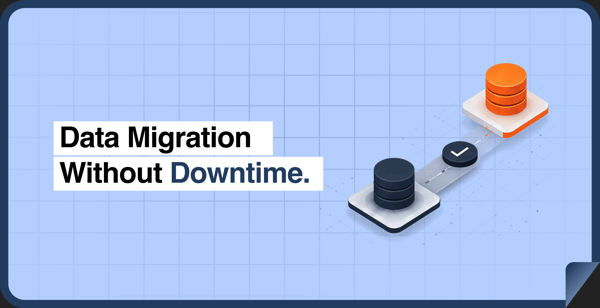
A CRM, ERP, service desk, or marketing platform does not become quiet just because a migration has started.
Sales teams keep updating opportunities. Support agents keep resolving tickets. Forms continue creating leads. Finance systems continue posting transactions. Every change made after the first export creates a gap between the source and the destination.
Data migration without downtime is the discipline of closing that gap while users continue working. Historical records move first, live changes follow through an incremental sync, and the final cutover is reduced to a short, controlled write freeze rather than a prolonged system outage.
This guide explains the architecture, preparation, execution, validation, rollback, and operational controls required for a zero-downtime data migration.
Zero-downtime data migration is a migration approach that keeps the source system available during most of the project while data is copied and synchronized to the target.
The term does not always mean that nobody experiences a single second of restricted access. In most business-system migrations, it means the interruption is reduced to a short final window used to freeze writes, sync the last changes, validate parity, and redirect users and integrations.
The objective is operational continuity:
Downtime is not only the period when an application is unavailable. It also includes the reconciliation backlog created when users work in spreadsheets, email, or offline notes during an outage. If that activity must be entered manually after launch, the migration has deferred the downtime instead of eliminating it.
Most zero-downtime migrations use two data movements.
The backfill moves the large body of records that already exists. It can include customers, contacts, closed opportunities, resolved tickets, past activities, products, transactions, and other historical objects.
Because much of this information is static or changes infrequently, it can be moved in bulk while users continue working in the source.
The delta process captures data created, updated, deleted, merged, or otherwise changed after the backfill's extraction point.
It may use source modification timestamps, webhooks, change-event streams, audit logs, or periodic comparisons. Each change is applied to the target through an idempotent operation, normally using a preserved source ID as the external key.
When the backfill is complete and the delta lag is close to zero, the team briefly freezes writes in the source. It runs the final delta, executes reconciliation checks, redirects users and inbound integrations, and makes the target the new system of record.
The migration succeeds because the final window contains very little data movement. Most of the work has already been completed and validated.
Different environments need different continuity patterns.
|
Strategy |
Best suited for |
Main risk |
Cutover profile |
|---|---|---|---|
|
Historical backfill plus delta sync |
Most CRM, service, marketing, and operational migrations |
Missing creates, updates, deletes, or merges in the delta |
Short final write freeze |
|
Phased migration by object or team |
Large organizations that need a smaller blast radius |
Cross-object dependencies remain live for longer |
Several controlled cutovers |
|
Bi-directional synchronization |
Coexistence where both systems must remain writable |
Conflicts and silent overwrites |
Gradual transition |
|
Parallel run |
Finance or high-stakes operational systems requiring output comparison |
Cost, duplicate effort, and a longer transition |
Cutover after proven equivalence |
For most CRM migrations, historical backfill plus delta sync is the practical default. It separates high-volume static history from the much smaller stream of live changes.
Use bi-directional sync only when both systems must be authoritative at the same time. That model requires explicit conflict rules, such as field-level system ownership or a carefully governed last-write policy. Without them, a stale update in one system can overwrite a newer value in the other.
List every standard and custom object, including contacts, companies, deals, tickets, products, line items, quotes, activities, attachments, and users.
For each object, document its associations and cardinality. A record count may confirm that 50,000 contacts moved, but it does not confirm that those contacts remain connected to the right companies, deals, and activities.
Document every system that reads from or writes to the source: forms, dialers, billing tools, data warehouses, enrichment services, email tools, reporting platforms, webhooks, workflows, routing rules, and scheduled jobs.
Record the owner, authentication method, objects touched, direction of data flow, and the cutover action for each integration.
Separate data into:
Map source fields, destination fields, data types, required values, picklists, owners, formulas, rollups, and transformation logic.
Preserve the original source record ID in the destination. This external key supports deduplication, repeatable upserts, association reconstruction, and source-to-target reconciliation.
Set measurable go/no-go criteria, including:
“The import finished” is not a success criterion.
Create the destination schema, users, roles, properties, pipelines, objects, and required integrations before loading production data. Rebuild workflows and routing logic in a safe state so they can be tested without affecting customers.
Execute the entire sequence for one object, one team, or a carefully selected sample. Include records with multiple associations, unusual field values, inactive owners, and active automation dependencies.
The pilot must validate the process, not simply prove that a clean CSV can be imported.
Load parent objects before dependent records. Use batch APIs or bulk tools appropriate to each platform, and control concurrency so the migration does not starve business-critical integrations.
Use retries with backoff for temporary errors. Keep operations idempotent so reprocessing the same batch updates the intended record instead of creating a duplicate.
Capture every record changed after the backfill's high-water mark. Track the last successfully processed timestamp or change token and monitor how far the target lags behind the source.
The delta must account for more than updates. Deletes, merges, ownership changes, relationship changes, and schema changes can be missed by a simple “modified since” query.
Imports can trigger workflows, notifications, lead routing, sequences, customer emails, and ticket escalations. Disable or suppress customer-facing automation until the migrated records have been validated and protected from unintended enrollment.
Prepare every inbound and outbound integration for the target, but activate it according to the cutover plan. Until the system of record changes, do not allow uncontrolled writes into both systems.
Run automated comparisons throughout the migration. Join source and target data on the preserved legacy ID and report mismatches in counts, fields, owners, and associations.
Reconciliation should be a repeatable job, not a one-time spreadsheet exercise.
Compare values for dates, currencies, dropdowns, multi-select fields, ownership, status, and required properties. Explain every count difference rather than accepting a roughly similar total.
Confirm that contacts link to the correct companies, deals link to the correct contacts and line items, tickets retain the right customer and conversation history, and custom-object relationships are complete.
Manually compare the largest open deals, highest-value customers, active escalations, and records tied to important workflows. These records carry greater operational risk than a random row.
Rebuild critical dashboards and compare their outputs with the source. Test routing, notifications, lifecycle changes, customer communications, and downstream integrations using controlled records.
If the validation gate fails, do not improvise under pressure. Follow the rollback plan.
A rollback plan is designed before cutover and tested during rehearsal.
Do not decommission the source immediately. Keep it available as a reference and fallback through a defined stabilization period.
Use measurable conditions, such as:
Name the person authorized to stop the cutover or invoke rollback. Incident response needs a clear decision-maker.
The plan should explain how to stop target writes, redirect inbound traffic, restore the previous system-of-record status, reverse or remove the failed load where possible, and communicate the decision to users.
Rollback is not failure. An uncontrolled launch without a recoverable path is failure.
Migration traffic can exceed normal platform usage. Use batching, concurrency controls, retries, and backoff. Confirm the current limits for the specific subscriptions, APIs, and connected applications involved.
Timestamp polling may capture updates but miss deletes, merges, and relationship changes. Combine change events, soft-delete indicators, audit data, or periodic full reconciliation as needed.
A new required field or changed picklist can invalidate a tested mapping. Freeze source schema changes or route every change through migration governance.
Imported records can meet enrollment conditions and send messages or create tasks. Suppress outbound behavior until the target data and trigger criteria have been verified.
Moving an email address without its subscription and withdrawal history can re-enable communication to someone who opted out. Treat consent as first-class data, not a boolean afterthought.
A form or billing tool left pointing to the source can continue creating records in a system users no longer monitor. Test every redirected inbound and outbound path after cutover.
The right number of records can still contain wrong values and broken relationships. Reconcile fields and associations, not only rows.
Zero-downtime migration demands more than a fast bulk import. It requires continuous change capture, repeatable mapping, association preservation, validation, retries, and a controlled final delta.
SuprSwitch by Suprdense is built to move CRM and service-desk data into HubSpot while users continue working in the source. It supports guided mapping, record and association validation, retry handling, and delta migration so the final cutover can be short and controlled.
Use SuprSwitch when business activity cannot pause and the migration needs to preserve the full context around each record, not just its field values.
Yes. A zero-downtime migration uses backfill, delta sync, and a controlled final cutover so users can continue working in the source system while data is migrated.
SuprSwitch uses delta migration to capture new and updated records after the initial backfill, helping keep the destination aligned with the source until cutover.
New or updated records can be captured through delta sync and migrated to the destination. This helps prevent changes made after the initial backfill from being missed.
Use stable record IDs, complete backfill, repeated delta syncs, relationship validation, error checks, and a final reconciliation before cutover. SuprSwitch supports validation and delta migration as part of this workflow.
Zero-downtime migration is better when the source system must remain operational and business teams cannot afford a prolonged write freeze or service interruption.
Discover ideas, strategies, and expertise to help you streamline operations, improve customer experiences, and accelerate growth.
