.webp?width=130&height=24&name=SuprConfig%20(2).webp)



 Book a migration call


CRM Migration vs CRM Implementation: What's the Difference?
-
Himanshi

- Date: September 10, 2026
- 12 min read

Config delivers 3,000 HOURS OF TIME-SAVINGS for a logistics-focused HubSpot Solutions Partner
How a logistics-focused HubSpot Solutions Partner reclaimed 3,000 hours in one month with Config
Read Full Case Study Not sure where to start? Talk to a migration expert

Migrate to HubSpot and connect your favouritetools all in one platform.

Migrate to HubSpot and connect your favouritetools all in one platform.
How we consolidated years of data from Salesforce org and a legacy HubSpot Portal into a new HubSpot Instance for Salted Stone
How we consolidated years of data from Salesforce org and a legacy HubSpot Portal into a new HubSpot Instance for Salted Stone
Read Full Case Study
Not sure where to start? Talk to a migration expert
Import, create, and deply assets
Connect, map, and migrate CRM data
Deep dive into our technical setup guides.
See how clients transform CRM operations.
AI thinking and product news to unleash the potential
Read our latest product updates and insights.
Acquisition-Driven Consolidation of a Salesforce Org and a Legacy HubSpot Portal into a New HubSpot Instance
How a Global PropTech Scale-Up Consolidated 2.5M+ CRM Records into HubSpot in 18 Hours 47 Minutes
Read Full Case Study
Not sure where to start? Talk to a migration expert
Not sure where to start? Talk to a migration expert
I've had this conversation more times than I can count. A RevOps lead buys HubSpot, adds the paid onboarding tier, and expects to wake up in six weeks with 60,000 Salesforce contacts migrated, 40 workflows rebuilt, and their custom deal pipeline live in production. Then week two arrives. The "onboarding" turns out to be a series of guided sessions where a HubSpot specialist teaches them how to build those things themselves. Nobody is migrating their data. Nobody is rebuilding their pipelines. The contract is signed, the timeline is locked, and the gap between what they bought and what they needed is now their problem to solve.
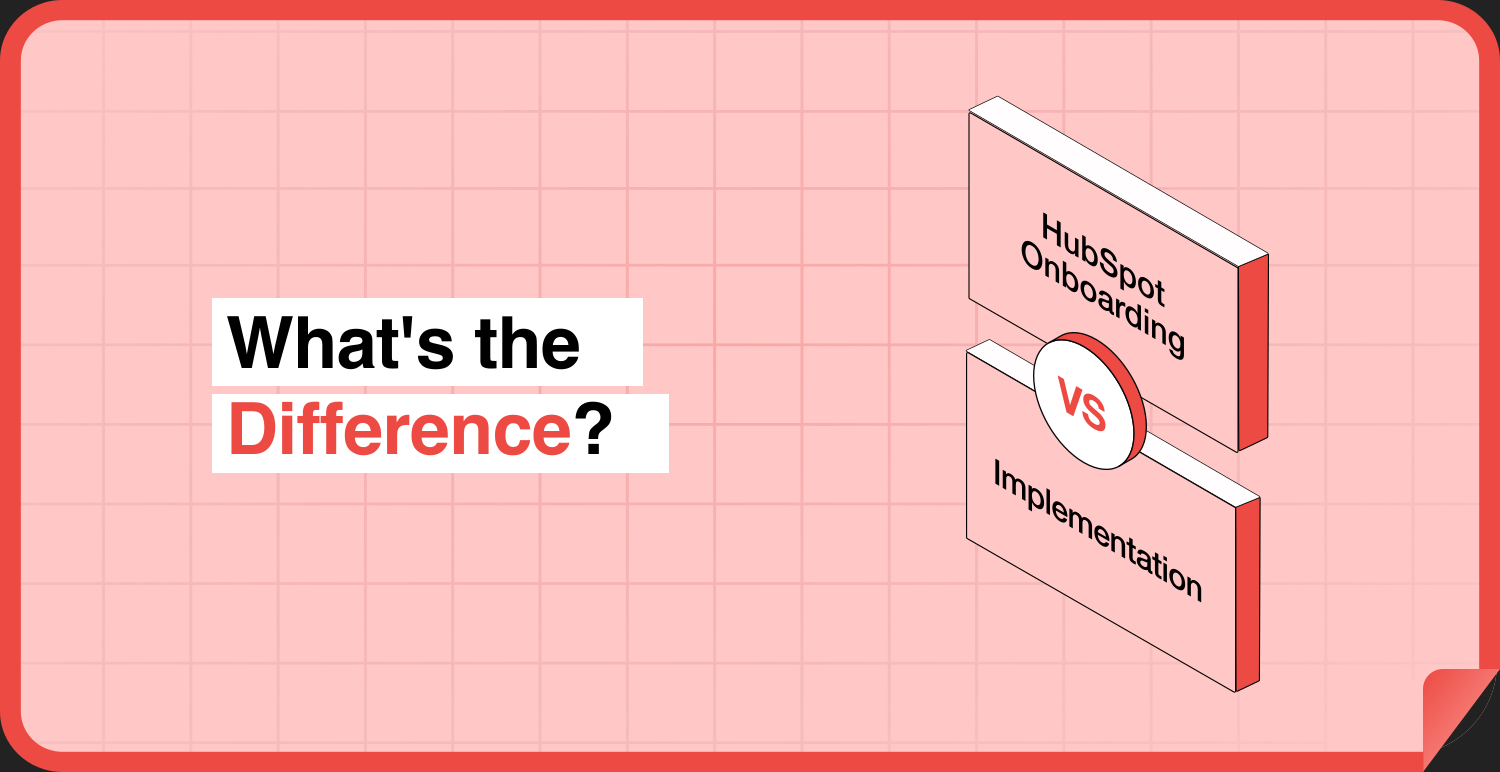
That gap is the whole point of this article. HubSpot onboarding vs implementation is not a semantic distinction. It's the difference between someone teaching you to use a tool and someone actually building your CRM. Confuse the two at scoping time and the mismatch shows up mid-project, after the money is committed. Let me draw the line clearly so you don't pay for guidance calls when what you needed was a migration and a data-model build.
Scope mismatch is the single most common source of friction I see in HubSpot projects.[1] The buyer expects a done-for-you system. The seller, whether that's HubSpot directly or a partner's onboarding tier, scoped a teach-you-the-tool engagement. Both sides think they agreed to the same thing. They didn't.
The failure mode is predictable. An agency quotes a fixed onboarding package. Then reality lands: the client has three custom objects that need mapping, three years of historical activity to preserve, and a five-stage sales pipeline that has to be rebuilt from scratch. Now the agency is staring at work that was never in the quote. They either eat the margin or renegotiate awkwardly with a client who was told "onboarding" covered it.
On the buyer side, the damage is trust. Teams announce "go-live" because onboarding is complete, the users know how to navigate HubSpot, but the instance isn't actually configured to reflect the business. Sales logs in the first week, can't find their deals in the right stages, and writes off the whole platform. You then spend the next quarter clawing back credibility you never needed to lose.
The root cause is simple. "Onboarding" and "implementation" get used as synonyms. They are not. They are two distinct workstreams, and when there's a CRM migration involved, there's a third.
HubSpot onboarding, whether it's HubSpot's own Professional or Enterprise onboarding or a partner's onboarding tier, is enablement. It's guided sessions, a success plan, and a specialist who teaches your team how to use the features you bought.[2] That's genuinely valuable work. Adoption is where most CRM investments die, and structured enablement moves the needle on it.
But be precise about what onboarding does not include:
Read HubSpot's own onboarding documentation and this is all there. The problem isn't that HubSpot hides it. It's that practitioners consistently misread "onboarding" as "setup." Onboarding ends when your people know how to use HubSpot. It does not end when HubSpot reflects your business.
Implementation is the build. It's the workstream that turns a blank HubSpot instance into a system that mirrors how your company actually sells, markets, and services customers. That means:
This is not teaching. This is building. And here's the part that catches agencies: most of this build work is repeatable. The same Sales Hub configuration, properties, pipeline, deal stages, core workflows, and permission structure, gets rebuilt by hand for client after client. An agency running 10 to 50 onboardings a year that hand-builds each Sales Hub setup burns 1 to 2 admin days per client on configuration alone,[3] before a single client-facing enablement session happens. That's the hidden cost of treating the build as if it were part of onboarding.
This is exactly where SuprConfig lives. Config is the implementation layer, not the onboarding layer. It deploys a fully configured Sales, Marketing, or Service Hub module, properties, property groups, pipelines, deal stages, workflows, and user permissions, from sandbox to production in one click. The two days of manual rebuild collapse into roughly a twelve-minute deployment. You build and test your configuration in a sandbox, then move the module intact to production without drift or manual re-entry.
To be clear about the boundary: Suprdense Config deploys configuration, not data. It does not migrate records, and it does not run your client-training sessions. It handles the repeatable build layer, which is precisely the part that shouldn't be manual.
Implementation builds the instance. Onboarding enables the people. The sequence matters more than most teams realize: you don't onboard on a half-built system.
When you run enablement sessions on an instance that isn't finished, pipelines still in default state, properties missing, workflows not yet live, you're teaching people to use something that will change under them next week. Every training session you run against an incomplete build is a session you'll partially redo. Worse, you erode confidence. Reps learn a layout that then shifts, and they conclude the platform is unstable.
The clean handoff looks like this. Implementation finishes the build. The data model reflects the business, pipelines match the real sales process, permissions are set, and automation is live. Only then does onboarding begin, teaching people to work inside a system that's actually done. When the build is deployed cleanly through Suprdense CONFIG's one-click hub deployment, that handoff is crisp: the configuration is in production, verified, and stable before the first enablement call.
Here's the part that wrecks timelines. If you're moving off Salesforce, Pipedrive, or Zoho, that's a migration, and migration is neither onboarding nor standard implementation. It's a third workstream with its own failure modes, and a standard onboarding checklist never touches any of them.
A mid-market Salesforce org with custom objects and active workflows is a 3 to 6 week migration project when done carefully, covering validation, deduplication, association mapping, and ownership transfer.[4] Try to bundle that into a 30-day onboarding and the project slips by definition. The specific traps:
This is SuprSwitch territory. SuprSwitch handles migration specifically: contextual object mapping, real-time record validation, association integrity, and ownership transfer, without storing your customer data on the platform. Its real-time record validation flags a failed record the moment it doesn't appear in HubSpot within the expected window, rather than letting you discover the gap three weeks later in a support ticket. The point for scoping: migration, implementation, and onboarding are three distinct workstreams. Suprdense CONFIG addresses the implementation build, SuprSwitch addresses the migration, and onboarding is the enablement on top.
Before you sign anything, answer one question honestly: are you buying enablement, a build, a migration, or all three? Most buyers need at least two of the three but scope for one.
Run this checklist:
If the answer to the first two questions is "no," which it almost always is for a new buyer, then buying onboarding alone leaves you with a system nobody built and data that never moved. That's the mismatch, spelled out before you sign instead of discovered in week two.
For agencies, conflating the two workstreams doesn't just create friction. It destroys repeatability and eats margin. If you're hand-building each client's Sales Hub configuration, you're re-solving a solved problem every engagement and never templatizing the build layer.
The fix is to separate the build cost from the enablement cost explicitly. Use Suprdense CONFIG to productize the implementation build: deploy a proven, tested configuration across clients instead of rebuilding from scratch. Build your reference Sales Hub module once in a sandbox, then use one-click hub deployment to push it to each client's production instance in minutes. The 1 to 2 admin days per client that used to disappear into manual setup now go to the client-facing enablement that clients actually perceive as value.
That's the operating model that scales. Config handles the repeatable build, SuprSwitch handles migration when a client is coming off another CRM, and your team's hours go to strategy and training instead of clicking through property setup for the fortieth time.
No. HubSpot's Professional and Enterprise onboarding is delivered as guided sessions and a success plan focused on enablement.[2] It explicitly excludes data migration, custom development, and hands-on configuration of your specific processes. If you're moving records from another CRM, that's a separate migration workstream, SuprSwitch territory, not something the onboarding tier covers.
Only if your instance is already fully configured and your data is already in HubSpot. For a new buyer, neither is true. The pipelines aren't built, the properties don't exist, the workflows aren't live, and the data is still sitting in your old CRM. Onboarding teaches people to use a system, it doesn't build one. Skip implementation and you'll be onboarding your team onto an empty instance.
Onboarding runs as weeks of guided enablement sessions. Implementation depends on data complexity, custom objects, and integrations, so the build itself can take days to weeks. The repeatable configuration layer, though, doesn't have to take days. With Suprdense CONFIG's one-click hub deployment, deploying a full Sales Hub module compresses from roughly two admin days to about twelve minutes.[3] If a migration is also involved, add 3 to 6 weeks for a mid-market org with custom objects and active workflows.[4]
Neither, exactly. It's a migration layered on top of implementation, with onboarding after. You have three distinct workstreams: move the data (migration), build the instance (implementation), teach the people (onboarding). Watch specifically for the Activities split. Salesforce separates Tasks and Events, HubSpot unifies them, which is a classic way to lose call and meeting history if your migration doesn't handle it.
Templatize the build. Instead of hand-configuring each client's Sales Hub, build a reference module once and deploy it with Suprdense CONFIG. Its one-click hub deployment moves properties, pipelines, deal stages, workflows, and permissions from sandbox to production intact, so you separate the repeatable build cost from the enablement work. That protects margin and frees up admin hours.
Onboarding teaches your people. Implementation builds your system. Migration moves your data. Three workstreams, three timelines, three sets of failure modes, and the expensive mistake is scoping one when you needed all three. That confusion doesn't stay hidden. It surfaces in week two, after the contract is signed and the timeline is fixed, when the reality of custom object mapping and historical activity migration hits a package that was priced for guidance calls.
Scope it correctly at the start and the whole project changes shape. Build first, migrate carefully, enable last, and never train a team on a half-built instance. That sequence protects both the timeline and the trust of the sales team who'll judge HubSpot in their first week using it.
For agencies, the leverage is in separating the build from the teach. Suprdense CONFIG handles the repeatable implementation build so your hours go where clients actually see value, and when a client is coming off another CRM, SuprSwitch handles the migration as the distinct workstream it is. Name the three workstreams before you sign. That's the difference between a project that lands and one that slips.
HubSpot onboarding focuses on enablement and teaches teams how to use the platform, while implementation involves building and configuring HubSpot around the business's processes, data model, automation, permissions, and integrations.
No. Onboarding is primarily an enablement service and does not replace hands-on implementation. If a business needs its pipelines, properties, workflows, permissions, and other processes configured, it needs an implementation workstream.
No. Data migration is a separate workstream that involves moving records, mapping objects and associations, handling ownership, deduplicating data, and validating the migrated records.
In most cases, implementation should happen before onboarding. Teams can be trained more effectively when the HubSpot instance is already configured around their actual processes rather than learning on a system that will change later.
Implementation builds and configures the HubSpot environment, while migration moves existing CRM data into that environment. When switching from another CRM, both workstreams may be required before user onboarding begins.
A typical sequence is to configure the HubSpot environment, migrate and validate the required data, and then onboard users on the completed system. Keeping these workstreams separate helps prevent training from taking place on an incomplete or changing setup.
Discover ideas, strategies, and expertise to help you streamline operations, improve customer experiences, and accelerate growth.
