.webp?width=130&height=24&name=SuprConfig%20(2).webp)



 Book a migration call


Salted Stone Unified Salesforce and HubSpot in Under 19 Hours
View case study

Config delivers 3,000 HOURS OF TIME-SAVINGS for a logistics-focused HubSpot Solutions Partner
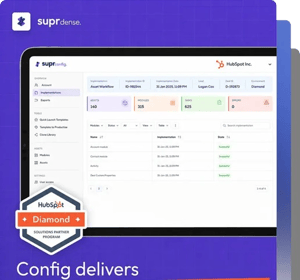
How a logistics-focused HubSpot Solutions Partner reclaimed 3,000 hours in one month with Config
Read Full Case Study Not sure where to start? Talk to a migration expert

Migrate to HubSpot and connect your favouritetools all in one platform.

Migrate to HubSpot and connect your favouritetools all in one platform.
How we consolidated years of data from Salesforce org and a legacy HubSpot Portal into a new HubSpot Instance for Salted Stone
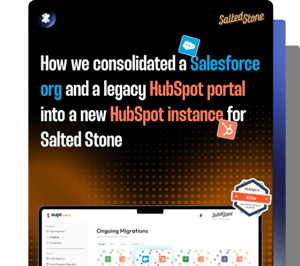
How we consolidated years of data from Salesforce org and a legacy HubSpot Portal into a new HubSpot Instance for Salted Stone
Read Full Case Study
Not sure where to start? Talk to a migration expert
Import, create, and deply assets
Connect, map, and migrate CRM data
Deep dive into our technical setup guides.
See how clients transform CRM operations.
AI thinking and product news to unleash the potential
Read our latest product updates and insights.
Acquisition-Driven Consolidation of a Salesforce Org and a Legacy HubSpot Portal into a New HubSpot Instance
How a Global PropTech Scale-Up Consolidated 2.5M+ CRM Records into HubSpot in 18 Hours 47 Minutes
Read Full Case Study
Not sure where to start? Talk to a migration expert
Not sure where to start? Talk to a migration expert
.png?width=550&name=Untitled%20design%20(4).png)
180+
Eloqua and Pardot assets restructured and migrated
50+
workflows rebuilt in HubSpot
6+
Lead sources consolidated into one HubSpot system
Keysight Technologies is a global electronic design and test solutions company headquartered in the United States. This program supported its DES portfolio, including acquired brands and regional teams operating with different marketing platforms, Salesforce environments and go-to-market models.
Visit ↗Electronic design and test solutions
Global; headquartered in the United States
Growth through acquisition had given Keysight's DES portfolio more reach, more products and more routes to market. It had also produced a fragmented operating landscape. ESI ran Pardot with a standalone Salesforce org. EDA and Cliosoft used Eloqua with Keysight Salesforce. Eggplant had its own HubSpot and Salesforce environments, while Orion and the Portugal teams still relied on legacy systems.
The fragmentation reached beyond technology. Business units used different fields, lead sources, MQL definitions and Salesforce data models. Some followed a one-contact-to-one-lead model in which only qualified contacts synchronized to Salesforce. Others created a new lead for every form submission and routed it according to product line.
Without a shared foundation, Keysight could not create consistent reporting or attribution across the portfolio. Campaign teams worked across separate platforms, operations teams maintained overlapping integrations, and every acquisition introduced another layer of routing and governance complexity.
OneMetric designed a phased consolidation program around a single Keysight HubSpot instance and the corporate Salesforce environment. The work combined architecture discovery, data-model standardization, asset migration, Salesforce integration redesign, lifecycle deployment and brand-by-brand testing.
Keysight was not migrating one marketing platform. It was bringing several acquisition histories into a shared environment. ESI moved from Pardot and a standalone Salesforce org into Keysight HubSpot and Salesforce. EDA and Cliosoft moved from Eloqua into Keysight HubSpot, while Eggplant, Orion and the Portugal teams entered the same destination through separate migration paths.
The team began with discovery and architecture rather than bulk transfer. Assets were inventoried, dependencies were identified and the destination model was defined before production migration. That sequence allowed each brand's forms, campaigns and automation to be restructured for the shared environment instead of reproducing the source-system fragmentation inside HubSpot.
Across the program, more than 180 Eloqua and Pardot assets were restructured and migrated. The result was one centralized marketing platform that reduced the operating burden of maintaining Pardot, Eloqua and multiple HubSpot portals in parallel.
Outcome: 180+ Eloqua and Pardot assets moved into one governed HubSpot foundation.
A single platform did not mean every business unit could use the same lead logic. ESI and Eggplant followed a one-contact-to-one-lead model, with MQL status controlling when a record synchronized to Salesforce. Other business units treated every form submission as a separate lead associated with a specific product line.
OneMetric standardized the common layer first: fields, lead sources, lifecycle stages and the mappings required by Keysight Salesforce. Business-unit rules were then applied on top of that foundation, allowing the destination to use one governed data language without erasing the differences that mattered to each sales motion.
Lead-source normalization brought more than six source structures into the shared model. This gave marketing and operations teams a consistent basis for reporting while preserving the product-level context required for routing and follow-up.
One governed data model created consistency underneath the process, while business-unit routing preserved how each team generated demand.
The Salesforce transition could not happen as a single cutover. Keysight HubSpot needed to synchronize with the corporate Salesforce environment as the primary destination while Eggplant continued using a temporary parallel Salesforce connection until its org could be migrated.
The integration design therefore required field-level alignment across multiple orgs, custom synchronization rules and clear ownership of record creation. MQL gates controlled which records entered Salesforce for ESI and Eggplant, while other business units routed lead records according to product-line logic.
Duplicate-prevention and sync-governance rules protected Salesforce data quality while the wider consolidation continued. Keysight gained a standardized integration model without forcing unfinished source-system work into the production schedule.
The architecture supported a governed primary Salesforce connection and a temporary parallel sync without allowing the two models to conflict.
Once the destination architecture and data model were established, the team rebuilt the operational layer inside HubSpot. More than 50 workflows were recreated to support lead qualification, Salesforce synchronization, product-line routing, attribution and multi-brand governance.
The rollout was tested brand by brand so that shared rules and business-unit exceptions could be validated together. New lifecycle and attribution models gave teams a common way to define progression, while centralized reporting provided leadership with visibility across the DES portfolio.
Centralizing the marketing platform also made campaign deployment faster. Teams could work from one governed operating system instead of recreating processes across separate platforms and portals.
Outcome: 50+ workflows rebuilt, cleaner Salesforce routing and one reporting foundation across DES brands.
Keysight replaced a fragmented acquisition stack with one centralized HubSpot environment and a standardized Salesforce integration model. More than six lead sources entered a shared structure, giving teams a consistent basis for lifecycle management, routing and attribution.
The program improved MQL discipline across brands, increased Salesforce data cleanliness and routing accuracy, and gave leadership broader visibility across the DES portfolio. Centralized campaign operations also reduced the friction of deploying marketing activity across multiple platforms.
The transformation did not force every business unit into one sales motion. It standardized the infrastructure around those motions so that acquisition growth could scale with clearer governance.
Keysight did more than replace a collection of marketing platforms. It created a shared operating foundation for acquired brands: one HubSpot instance, standardized data structures, controlled Salesforce synchronization and lifecycle automation that respected different go-to-market motions.
With 180+ assets migrated, 50+ workflows rebuilt and 6+ lead sources consolidated, the DES portfolio gained a cleaner path for campaign execution, routing and reporting. The architecture also created a foundation for the next phase of the program, including the planned Eggplant Salesforce migration, expanded intent-data sources, advanced attribution, multi-touch modelling and Breeze AI automation.